Fortunately, dental implants are not the only way to restore your smile. There are many dental implant alternatives designed to suit every budget and individual health condition.
In this guide, we will take you on a quick tour of the most prominent options available for replacing missing teeth, starting with fixed bridges, moving on to dentures, and concluding with a comprehensive comparison to help you make the most appropriate decision for you.
When Does a Patient Look for an Alternative to Dental Implants?
The search for dental implant alternatives begins for several reasons, which can be summarized as follows:
- High Cost: Implants are a higher-priced procedure compared to others, which may not fit many patients' budgets.
- Lack of Jawbone Density: Sometimes, the jaw does not have enough bone to support the implant, and the doctor may have to perform a prior bone grafting procedure—an extra step some prefer to avoid.
- Fear of Surgery: Many people are afraid of the idea of surgery itself, whether due to expected pain or the possibility of complications.
- Concern about Bleeding: Some patients may be more prone to bleeding due to their medical history.
- Chronic Diseases: A medical condition that prevents gum surgery, such as uncontrolled diabetes, may prompt the doctor to suggest alternatives to dental implants.
- Presence of Healthy Roots: If the tooth roots are still in good condition, resorting to one of the alternatives becomes the optimal and simplest solution.
Medical advancement in the field of implants itself has not stopped; new techniques have emerged, such as laser dental implants and flapless dental implants. However, some patients still prefer to avoid surgery entirely and opt for traditional dental implant alternatives
Read more: My experience with dental implants

Alternative One: Dental Bridges
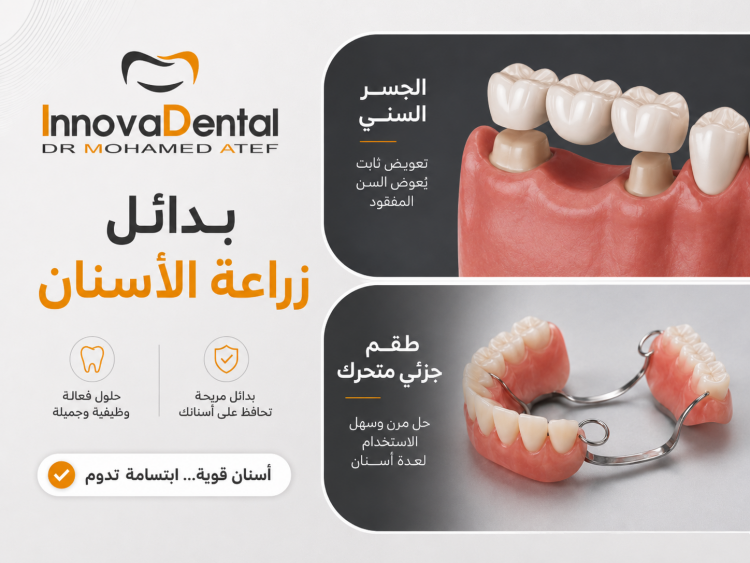
A dental bridge is a smart solution to fill the gap caused by one or more missing teeth. It relies on adjacent teeth to anchor the replacement tooth in the place of the missing one, giving you a symmetrical appearance and a sense of stability similar to natural teeth.
How is a Dental Bridge Placed?
A dental bridge is placed through several steps, in the following order:
- The dentist cleans the teeth surrounding the missing tooth and removes any existing decay.
- Next, they shave down these adjacent teeth, preparing them to serve as a strong support (abutment) for the bridge.
- An accurate impression of the teeth is taken to reflect their true dimensions.
- The dentist sends this impression to a specialized laboratory to fabricate a custom-fitted bridge.
- A temporary bridge is placed to protect the teeth until the permanent bridge is ready.
- During the second visit, the dentist tries out the bridge, determines the appropriate shade, and adjusts its fit.
- In the third and final visit, the dentist permanently cements the bridge so you can enjoy your new smile.
In this regard, the Mayo Clinic website explains that while dental implant surgery is an effective and long-lasting solution, its success depends heavily on the patient's overall health and the strength of their jawbone to support the implants. Reports published on the website confirm that medical contraindications that prevent bone healing or make surgical intervention risky make alternative prosthetic options a safe and recommended medical choice.
Advantages of Dental Bridges
Dental bridges enjoy widespread popularity among implant alternatives for several reasons, including
- Restores your ability to chew food properly and speak clearly, just as you did before losing the tooth.
- Designed to match the color and shape of your natural teeth, enhancing your smile and boosting your self-confidence.
- Once securely cemented, it becomes fixed and stable, eliminating any worries during daily use.
- Helps keep remaining healthy teeth in their proper positions and maintains the overall shape of the mouth.
- Can be designed and placed in a relatively shorter time compared to implants and certain other methods.
Serious Disadvantages of Bridges
Despite all these advantages, a dental bridge is not without some drawbacks that you should be aware of before making your decision. Therefore, it remains an alternative that requires careful consideration. These disadvantages include:
- Sacrificing Healthy Teeth: Placing a bridge requires shaving down adjacent teeth to fit crowns over them, which means losing a portion of your healthy teeth.
- Pressure on Supporting Teeth: The two adjacent teeth bear additional pressure, which may cause problems over time.
- Potential Nerve Problems: Unforeseen nerve issues in the supporting tooth may arise after a while.
- Plaque Accumulation: If not fitted correctly, plaque and tartar can accumulate around and under the bridge, causing bad breath and increasing the risk of decay.
- Gum Irritation: Neglecting oral hygiene or an imprecise fit can lead to inflammation and periodontal pocket issues.
- Limited Lifespan: The bridge may wear out over time, meaning you will eventually need to replace it.
Alternative Two: Dentures
If budget is your most important factor, dentures are among the most cost-effective alternatives to dental implant . They are divided into two main types: a partial denture, and a complete denture that replaces an entire row of teeth.
Removable Partial Dentures
A partial denture is a type of removable appliance that replaces one or more missing teeth. It consists of a pink acrylic or metal base with artificial teeth attached that mimic natural ones. It is often chosen by those looking for a quick and easy removable denture without any surgical intervention.
Complete Dentures
A complete denture is the solution for someone who has lost all or most of their teeth in the upper or lower jaw. This denture can be permanently affixed over a number of artificial implants placed in the jaw, completely replacing the missing natural teeth.
This concept relies on placing a series of implants in the jaw, then attaching permanent artificial teeth over them after healing and proper osseointegration (fusion between the implants and surrounding bone) occur. This provides the patient with a permanent solution that fully restores dental function. A fixed denture of this type can also be placed, offering an option that combines both function and aesthetics.
Advantages and Disadvantages of Dentures
The pros and cons of dentures include the following
Read more: Dental Implants Before and After

1. Advantages of Dentures
- Relatively lower cost compared to fixed prosthetics and implants.
- Maintains the shape of your smile by replacing missing teeth.
- Does not require any surgical intervention like implants do.
- Preserves the space of the missing tooth, as gaps can cause adjacent teeth to shift.
2. Disadvantages of Dentures
- Requires an adjustment period, and you may experience some initial discomfort.
- Plaque can accumulate around supporting teeth, increasing the risk of decay and gingivitis.
- Pressure and movement during chewing can negatively affect the supporting teeth and gums.
- Potential bone loss in the areas of missing teeth, which later affects adjacent teeth.
- May not provide the same chewing efficiency as fixed restorations.
- May require adjustment or replacement.
Comprehensive Comparison: Dental Implants vs. Available Alternatives
Now that you are familiar with each option individually, you might be wondering whether to choose an implant or one of the alternatives. The truth is that each has its strengths and weaknesses, and the optimal choice depends on your condition, budget, and priorities. The following table provides a quick comparison of all the options:
|
Comparison Point |
Dental Implants |
Dental Bridges |
Dentures |
|
Cost |
Highest cost |
Medium cost |
Lowest cost |
|
Stability |
Completely fixed |
Completely fixed |
Removable |
|
Impact on Adjacent Teeth |
Unaffected |
Shaved down and affected |
May be affected by pressure |
|
Lifespan |
Very long |
Limited |
Limited |
|
Procedure Speed |
Takes months |
2 to 3 visits |
2 to 3 visits |
It cannot be said that one option is absolutely better than another. If your goal is a permanent, natural-looking solution and your budget allows, implants are the ideal choice. If you seek speed and stability at a lower cost, a bridge is suitable for you. However, if your primary goal is the lowest cost, dentures are a practical choice
In this context, the global medical website WebMD reports that dental implants are the gold standard and most sustainable option for replacing missing teeth. They provide strong support that mimics natural tooth roots and prevents jawbone loss. Despite the high success rates of implants, experts on the site emphasize that certain health conditions or financial constraints may prevent some individuals from undergoing this procedure, making alternative prosthetic options a wise and necessary medical decision.
Is There an Alternative to Jaw Bone Grafting?
Yes. Although bone grafting is a common option to strengthen the jaw structure before implant placement, it is not the only method. Options include:
Full-Arch Dental Implants
This technique differs from a single tooth implant. The success of a single implant heavily depends on the quality and density of the bone at the implant site, which may require bone grafting if deficient.
A full arch, however, can be anchored to the jaw using only four to six implants that efficiently distribute the support force. If you have four to six sites with sufficient bone, the procedure can be performed without the need for additional bone grafting.
Zygomatic Implants
When bone loss is so severe that it does not even allow for grafting, zygomatic implants become an advanced and effective solution. These modern implants are longer than traditional ones, do not require jawbone grafting, and boast a higher success rate than implants placed in grafted bone.
These implants are also considered an ideal choice for those suffering from bone loss who need a full arch for the upper teeth, noting that they are not suitable for single-tooth implants.
Ultimately, settling on the optimal choice among dental implant alternatives is a decision that warrants careful consideration and specialist consultation. At Innova Clinic, we believe that every smile has a story worth caring for, and every case has a tailored solution.
We provide you with an elite team of doctors fully prepared to accurately evaluate your condition and explain every available option—from bridges and dentures to implants and bone grafting alternatives—so you can make the best and most appropriate choice. Book your appointment at Innova Clinic, and let us create a treatment plan to restore your smile anew.