The types of dental implants are a major consideration for anyone thinking about replacing missing teeth. Choosing the right type is not just a minor detail;
it is the cornerstone upon which the success of the procedure depends.
With a variety of techniques, materials, and countries of origin, understanding the differences between these types is essential to making an informed decision—one that combines quality, cost, and the desired long-term outcome.
In this comprehensive guide, we will take you on a tour of the different types of dental implants, exploring the unique features of each, the cases they suit best, and how to arrive at the optimal choice for your needs.
Types of Dental Implants by Procedure Technique
Based on the approach and timing, dental implant procedures are divided into several techniques. Each has specific indications that make it the right choice for a particular case:
Traditional (Delayed) Implants
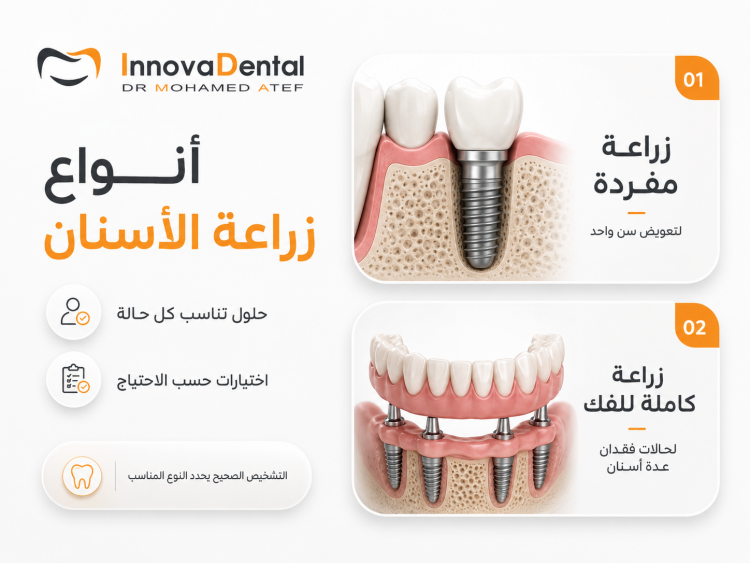
Traditional implants are the standard procedure for replacing missing teeth. A metal fixture is implanted into the jawbone to act as the root of the natural tooth.
The defining feature of this type is that the implant is left undisturbed for a sufficient period to fully integrate with the surrounding bone. Once this fusion is complete, the doctor attaches the artificial crown or tooth on top. This technique is often used when a patient requires bone preparation or a bone graft before the implant can be placed.

Immediate Loading Implants
Immediate implantation is a suitable solution for cases where a tooth cannot be saved due to deep decay affecting its tissue or a fracture in its roots.
The treating doctor extracts the damaged tooth and places the metal implant in its spot during the exact same session. Because it saves time and provides the patient with rapid results, it is especially preferred for cosmetic cases involving front teeth, provided the bone density is excellent enough to anchor the implant immediately without waiting.
All-on-4 and All-on-6 Techniques
These techniques target a different category of patients: those who have lost an entire arch of teeth and need a solution to restore a full row at once.
- All-on-4 Technique: Relies on securing only four implants per jaw, with the two posterior implants placed at a tilted angle. This clever method increases anchoring strength and maximizes the use of available bone.
- All-on-6 Technique: Similar to the previous method, but utilizes six implants per jaw instead of four. This provides additional support, making it ideal for patients who require higher functional performance during chewing or those with weaker bone density.
Types of Dental Implants by Material
In this context, the global medical website WebMD confirms that dental implants are the closest option to natural teeth in terms of form and function; the implants are designed to integrate completely with the jawbone, which not only provides a very solid foundation for the replacement teeth, but also protects the jawbone from erosion and atrophy over time, and these procedures record success rates exceeding 95% in most cases.
The differences between dental implants are not limited to technique alone; they also vary based on the material the implant itself is made of. The primary materials used include:
Titanium Implants
The unique properties of titanium make it the most widely used material. It is a highly durable and solid metal capable of withstanding various conditions inside the mouth for many years. More importantly, it is completely biocompatible; it does not react with the body, meaning the body will not reject it. Therefore, doctors consider it the ideal choice for patients suffering from gum or bone inflammation, or any oral infection.
Zirconia Implants (Metal-Free)
Read more: Dental Implants Before and After

Zirconia implants come as a single, integrated piece that combines both the root and the crown. They are the perfect choice for patients with metal or titanium allergies, or for precise aesthetic reasons. Key advantages include:
- Completely metal-free, eliminating any risk of allergic reactions.
- Reduces plaque and bacteria buildup on teeth and gums, positively impacting oral hygiene.
- Its color matches natural teeth, so even if the gums recede, no unnatural color will show.
- Provokes no reaction within the body, eliminating the risk of rejection and reducing inflammation around the tooth.
- Does not rust or corrode, and is free of side effects.
Read more:
My experience with dental implants
Comparison of Popular Dental Implant Brands
When discussing the best types of dental implants, the comparison is not solely based on the country of origin. It also depends on the implant type, the doctor's expertise, and the clinic's equipment. Since price is a crucial factor for every patient, the following table outlines the approximate costs of the most famous available brands:
|
Brand / Country of Origin |
Average Price (EGP) |
Key Characteristic |
|
Korean |
6,000 – 9,000 |
The most requested economical choice. |
|
Italian |
8,000 – 12,000 |
A moderate balance between cost and quality. |
|
German |
8,000 – 13,000 |
Highly requested for balancing quality and price. |
|
Swiss |
10,000 – 14,000 |
High stability and rapid bone integration. |
Looking at these figures, the prices of dental implants vary according to the country of origin and material quality. Below is a closer look at the most prominent and widespread implant brands.
Swiss Dental Implants
Swiss companies are at the forefront of advanced implant production, relying on high-precision technology and innovative materials. Two brands stand out:
- Straumann: Uses a material called Roxolid instead of pure titanium, which accelerates bone integration while preserving the health of the surrounding gums.
- Nobel Biocare: Relies on upgraded titanium and provides the doctor with a surgical guide, making implant placement more precise and safer.
Korean Dental Implants
Korean implants enjoy wide popularity because they combine high quality with an affordable price. The two most famous brands are:
- MegaGen: Features the AnyRidge system, which balances exceptional stability with fast healing. It is designed to offer high adhesion even in weak bone without needing extra procedures, making it ideal for immediate implants and those seeking a strong, budget-friendly solution.
- Osstem / Hiossen: One of the most widely used implant systems globally due to its high quality and reasonable price. It offers a guaranteed result at a modest cost, featuring easy installation, acceptable stability, and suitability for various bone types.
German and American Dental Implants (Precision Technology)
German and American implants share a reliance on advanced technologies, ranking them among the best globally. For American brands, two prominent names are:
- Zimmer Biomet: Uses Trabecular technology, which features microscopic pores allowing bone to grow directly into the implant body.
- Biohorizon: Utilizes Laser-Lok technology, which preserves gum tissue and accelerates implant healing.
German dental implants are renowned for their high quality, durability, and rapid bone integration, alongside a variety of designs to suit different cases.
Read more: Disadvantage of Dental Implants

Should I Choose Swiss or Korean Implants?
Patients are often torn between the two most popular choices: Swiss and Korean. The truth is that each has its specific uses and suitable medical cases. However, some key points can help guide the decision:
- If your priority is the absolute highest quality and longest lifespan, Swiss implants (like Straumann and Nobel Biocare) are the best fit. They combine rapid osseointegration with long-term stability, albeit at a higher price.
- If you want a relatively lower cost with excellent results, Korean implants (like MegaGen and Osstem) offer good stability and a high success rate, remaining a highly practical economical choice.
Types of Implants Based on Jaw Placement
The final classification of dental implant is based on where the fixture is anchored within the jaw, revealing how implants adapt to varying bone conditions.
Endosteal Implants
This is the most common and widely used type, where the implant is placed directly into the bone, exactly where the natural tooth root used to be.
Subperiosteal Implants
A strong metal titanium frame is custom-made and placed directly on top of the jawbone, beneath the thin tissue membrane covering the bone (the periosteum).
This frame has posts that protrude through the gums to act as anchors for a crown, bridge, or complete denture. Doctors typically do not use this as a first-line option; it is reserved for specific cases, such as:
- Patients with severe jawbone atrophy due to prolonged tooth loss, severe gum disease, or years of wearing traditional dentures.
- Those who lack the right conditions for a bone graft or wish to avoid it, due to medical conditions like uncontrolled diabetes or medications that hinder bone healing.
- Those who want to avoid a lengthy treatment period (which can last six to nine months) or dodge the need for multiple surgeries to harvest bone from other body parts.
Zygomatic Implants
These implants are designed specifically for complex cases, namely patients suffering from severe bone density loss in the upper jaw. Instead of relying on the jawbone, these implants anchor into the cheekbone (zygomatic bone) as a solid foundation. This grants them high stability even with extreme upper jawbone resorption.
Given the complexity of this procedure, its proximity to sensitive areas, and its typical use for supporting full-arch restorations, it requires a highly specialized surgeon to be performed safely.
How Does the Doctor Determine the Best Type for You?
The patient does not simply pick an implant type off a shelf; the doctor makes the decision after a careful study of your case. A sound medical decision is built on a combination of factors, primarily:
- Evaluating jawbone density and quality via a 3D CT scan (CBCT) to determine which implant type the bone can support.
- General health condition and the presence of chronic diseases or gum issues that might affect healing.
- The implant material (Titanium or Zirconia) and its compatibility with your body.
- The treating doctor's expertise.
- Balancing the total cost with the expected benefits.
- Your personal expectations regarding aesthetics and chewing functionality.
Ultimately, choosing the right dental implant requires expert guidance. At Innova Dental Clinic, we provide you with the latest technologies and the most skilled doctors to help you understand your condition and select the perfect implant for your bone and budget.
Do not hesitate to book your consultation with us today. Our medical team will accurately evaluate your case using advanced imaging and design a treatment plan customized exclusively for you.